Tuesday, 5 March 2013

Grain-free, Sugar-free, Dairy-free Banana Muffins

I hate wasting food. Do you know how much food we waste? Do you?!?! Let me tell you! Australians waste around 136 kilos of food per person each year! We toss away up to 20% of the food we purchase! It has been estimated that 20-40% of fruit and vegetables are rejected before they even get to the store, mostly due to aesthetic reasons e.g. bruising. Want more facts on how shamefully wasteful we are? Check out OzHarvest

Seriously people, this is a disgrace. I know everyone always says "think of the starving children in Africa", and you definitely should, but do you ever think about the starving people in Australia? Or do you consider the hard work that the farmers have put in to produce that food for you, just for you to say "that's not pretty enough for me to eat"? Do looks even really matter? What doesn't get used to refuel, repair and regenerate your body will just end up as poop anyway, and last time I checked, it's not too pretty! To be honest, I actually prefer buying produce that looks slightly tarnished - at least then you know it's normal and not covered with toxic waxes and chemicals (no, your apple probably should not be shiny). 

OK that's enough of a rant. This topic gets me a little worked up and considering I am trying to keep my stress levels in check, I'll get to the yummier and happier part of the post. 

The fantastic organic produce shop I go to (BU organics in Bondi Junction) nearly always has a box of food out the front that is a little older than the rest and so they give it away for free in order to encourage less waste. Brilliant - everyone wins! This past Sunday they had a whole lot of manky bananas - I'm talking mushy and brown - really manky. Quick pop quiz - what is the benefit of overripe bananas????? They are incredibly SWEET and fantastic to use in a recipe in place of sweeteners. Woo hoo! Straight away my brain (or tummy) screamed "BANANA MUFFINS!!!" and who was I to say no? So I bundled up the goods and was on my way to carry out another kitchen experiment (never mind the displeased husband who hates bananas). 
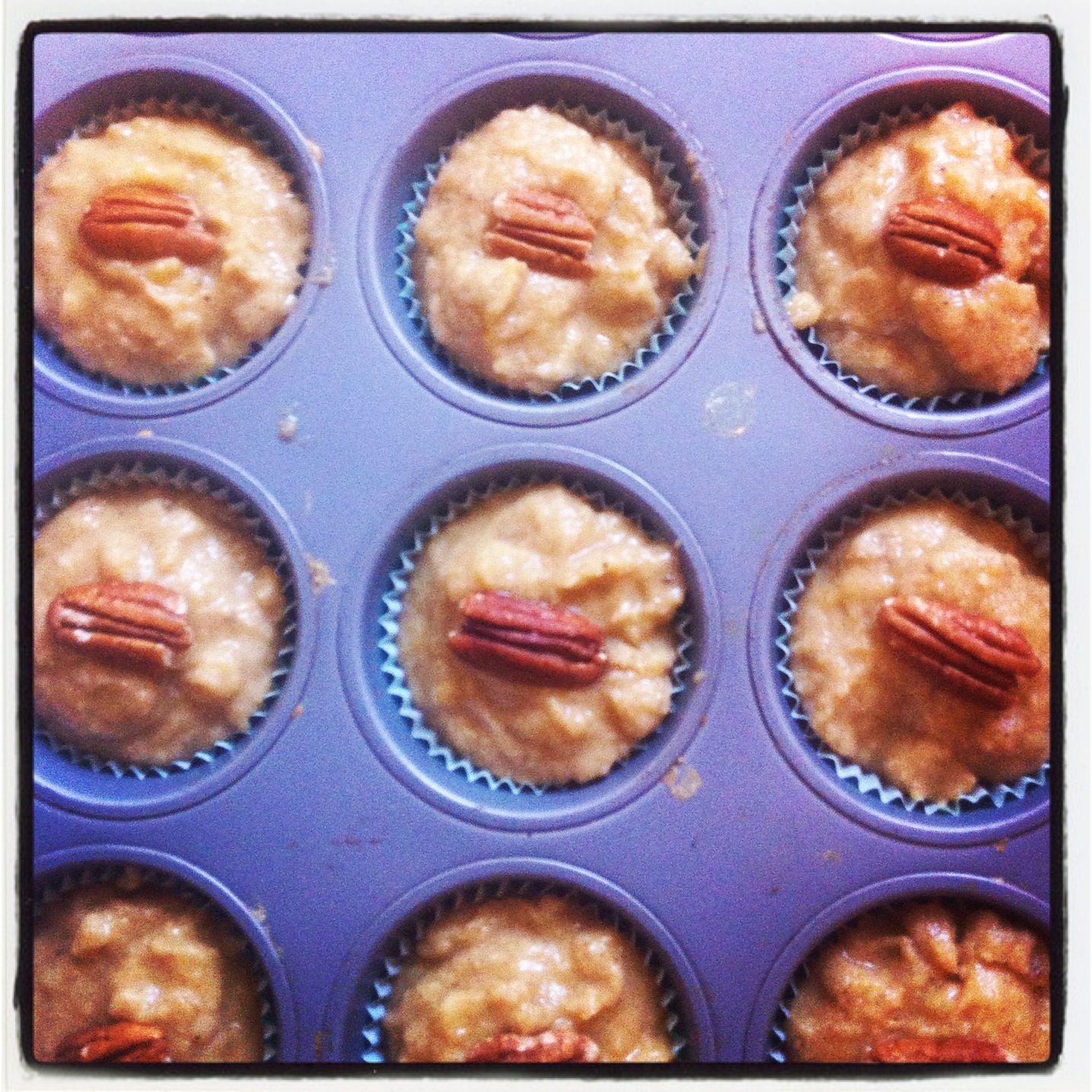
Banana Muffins pre-baking
The result? Moist, delicious, sugar-free, grain-free, dairy free morsels of goodness! I even received the tick of approval from my mother-of-4 client who usually pooh-poohs my healthy food (yes, these muffins are healthy). NEWSFLASH - healthy AND delicious can be used in the same sentence without the word "not".  These little babies were gobbled up by the clients at Primal Fitness in no time!

So I guess you want the recipe then, huh? OK, I give you permission to use, adapt, share, whatever you want to do with it if you promise to make a conscious effort to waste less food. Deal? OK good one.

Sugar-free, dairy-free, grain-free moist banana muffins/cupcakes (makes about 12 muffins)

Ingredients

  • 4 pastured eggs (my fave is Egganic )
  • 1 tbsp organic raw honey or maple syrup (you could leave this out as the bananas are quite sweet)
  • 2 tbspn coconut oil, melted
  • 1/2 tsp apple cider vinegar (Braggs Organic is best)
  • 3-4 overripe bananas 
  • 1/4 cup coconut milk
  • 1/2 cup coconut flour
  • 1/4 cup almond meal
  • 1/3 tsp vanilla powder (different to vanilla extract - buy it online professionalwhey.com.au)
  • 1 tsp cinnamon
  • 1 tsp gluten-free baking soda/powder
  • 1/2 tsp salt
  • 12 pecans
  • nutmeg
How to
  • Preheat oven to 175 degrees celsius
  • Beat together the honey/maple and coconut oil then add eggs one at a time, beating well after each one. Add in apple cider vinegar and beat well. 
  • In a separate bowl, mix all dry ingredients together and then slowly mix into coconut oil and honey/maple
  • Mash the bananas with the coconut milk in a bowl then add to the batter, mixing well
  • Line a cupcake tray with some patty cases (you could also just grease the tray with butter or coconut oil, but I'm lazy and don't like washing up)
  • Pour around 1/4 cup of batter into each patty case, topping each up if you have extra mixture
  • Place a single pecan and a sprinkle of nutmeg on top of each raw muffin
  • Bake for around 15-20mins until slightly browned and a skewer comes out clean
There you go! Now go and scrounge up some old, unloved, manky bananas that no one wants and turn them into something that everyone will love! 


Tuesday, 19 February 2013

Is your detox doing more harm than good?


Right now, it seems like every second person I run into is on some sort of "detox" program. On the one hand, this is great as it is an indication that people are actually investing some time and care into improving their health and wellness. On the other hand, the programs out there can vary from downright dodgy (I'm looking at you Lemon Detox) to potentially beneficial but often not as effective as they could be. Now don't get me wrong, this is not a post to discourage you from detoxing. This is simply to show you how to get the most out your detox so you become one of those annoyingly bubbly and energetic people who bounce through their day singing to the birds. Or like Peter Griffin from Family Guy after he has had a RedBull: 


I think in the world we live in today, some sort of regular deep "cleanse" is necessary. Not only are we consuming crappy foods and drinks, but we are surrounded by harmful toxins which can build up in our body and wreak havoc on our overall health and wellness. The problem with most detox programs is that they only focus on the food and drink aspect:

- no sugar
- no caffeine (currently doing this one at the moment and STRUGGLING! Thank god for nana naps and liquorice tea)
- no alcohol
- no meat
- no dairy
- lots of juices

There are a lot of "no's" in there! What about the "yes's"? While these approaches (with a few exceptions) may be helpful in lessening the future burden on our system, they do not fully address the toxic load that is already present, nor do they take into account the myriad of other ways our body is being flooded with harmful chemicals. Are you lost? Should I back up a few metres? 

OK, let's start with the liver…

Why would we start with the liver? Well it is our primary detox organ! It is the role of the liver to filter our blood before it enters the systemic circulation and gets carried to the rest of our organs and muscles etc. Not only does it process all of the food and drinks we consume, but it also deals with hormones, medications, alcohol, drugs and metabolic by-products, to name a few. If the liver is not functioning optimally, if it has too much work to do (I'll expand on this later) or if we are not providing it with adequate support during a detox then we may either not be reaping the full benefits of our cleanse or, we could be causing more damage than good!

WHAT? More damage with a detox? How??

Okey dokey, I apologise if this gets a bit nerdy but hey, that's who I am. I also want to point out that this is a very brief overview of how the liver detoxification system works. If you want to geek out further, feel free to get in touch! Also, feel free to skip this part and go straight to the tips on how you can make your detox more effective. 

Alright, are you ready? There are 3 phases of detox (however the third takes place in the kidneys). For effective detox, we need all phases working properly. In the liver, if one of the two phases is not working adequately, highly reactive by-products (i.e. toxins) can build up and cause cellular damage which may lead to further health issues throughout the body. Phase I reactions are essentially responsible for removing the garbage from your blood and processing chemicals to undergo phase II reactions. Let's stop here for a moment. The cleanse that you may be doing right now - all that juicing and healthy eating - that's in the realm of phase I detox. Good job - you are off to a great start! Most detoxes stop at this point. Why is this a problem? Because as I mentioned above, the metabolites from this phase, if not removed, can be incredibly harmful to the liver. SO….we need to look after phase II….

Phase II is very complex and involves a number of pathways that we do not need to go into here. In essence, phase II is responsible for "wrapping up" the harmful by-products from phase I into water-soluble "packages" so they can be excreted in the urine via the kidneys (or in bile via bowel movements). 

Let's cut to the chase - how do we get this "phase II" detox hip and happening? There are a number of things you should take into account when trying to get this baby working optimally:

1. Is your toxin load still too heavy for your liver to handle? I know what you're thinking - "No I'm juicing all organic vegetables, I'm not smoking, I'm not drinking, I've given up coffee. WHAT ELSE DO YOU WANT FROM ME!!??". Firstly, calm down - stress will only make matters worse. I want you to think about if you are still exposed to any of the following:

- The birth control pill - this nasty little monster will not only prevent your detox from being effective but may be doing long-term damage to your liver and entire hormonal system. I stopped taking the pill 2 years ago and things still have not returned to normal. GET OFF IT NOW! Ladies, if you really want to be healthy, get to know your cycle - take matters into your own hands. For more on this, read "The Garden of Fertility" by Katie Singer.
- Other medications - these all need to be processed by the liver and hence, add an additional burden. Please, ALWAYS consult your medical practitioner before stopping any medication. Not so fun fact - if you are taking a statin drug (for cholesterol) and you are dosing up on your grapefruit as part of your detox, STOP NOW!! Grapefruit juice inhibits the enzymes needed for the breakdown and clearance of statins and can lead to a toxic build-up in your body. 
- Skin care products, perfumes and cleaning products. Most are filled with incredibly harmful chemicals which not only increase the burden on your liver, but are potential "endocrine disruptors" which muck up your hormonal system leading to other complications. Go natural! I use olive oil of almond oil as a moisturiser now and my skin has never been softer (and that says a lot, considering I used to work for the #1 skincare brand in Australia). For more on this, check out The Environmental Working Group.
- are you eating or juicing too much fruit? While a little fresh fruit is absolutely beneficial, too much can be detrimental as fructose (the sugar found in fruit) has to be processed by the liver and is therefore adding yet another thing for the poor little over-worked organ to do. Fruit juice is much worse as it does not contain the fibre that whole fruit has and is therefore a greater hit to the liver. Try to stick with whole foods. If you must juice, stick with veggies and ALWAYS use filtered water. 

2. Are you supporting both phases of liver detox through nutritional or supplemental avenues? 

- A good phase I supplement is milk thistle extract. 
- In phase II, we really want to encourage the production of glutathione, our body's main anti-oxidant. How? Don't take a glutathione supplement - these are useless as they do not survive the digestive process. Instead, if you want a supplement, consider something with N-acetyl cysteine, which is the precursor to glutathione. Alpha-lipoic acid has also been shown to help. Speak to your healthcare practitioner about these. 

Foods to aid detox

- beetroot, carrots, capsicum, eggplant - "eat the rainbow" - brightly coloured veggies contain flavanoids and beta-carotene which are excellent anti-oxidants. Beetroot also helps with liver drainage.
- garlic - assists in removal of heavy metals from the liver
- brazil nuts - provide selenium which acts as an anti-oxidant and co-factor for glutathione action. Two brazil nuts per day are enough to provide you with your requirements
- eggs, broccoli and spinach - provide B-complex vitamins which are necessary in phase I to improve liver function and promote decongestion
- liver - eating liver helps your liver. SImple as that. Actually, it's more complex, but I have waffled enough today.
- cruciferous veggies such as broccoli, cauliflower and cabbage help the liver produce the enzymes necessary for detoxification. Note: minimise these if you have any thyroid issues
- dandelion greens (or tea), mustard greens, chicory - bitter vegetables increase the production and flow of bile and therefore aid excretion of waste products
- vitamin C-rich foods such as fresh orange (whole), berries, spinach, kiwi fruit. 
- radishes and watercress - rich in sulfur, necessary for glutathione production
- plenty of filtered water (not tap)

Some other ways to get the tox out of your body

- dry body brushing - this helps stimulate lymphatic drainage, thereby aiding the elimination of toxins from the body. I like to do this before my shower each morning with a dry bristle brush, using long strokes towards the heart with a fair bit of pressure
- sleep - vital for recovery and optimal wellness. If you are not getting good quality sleep in a dark room each night, then you are hindering your progress towards health and vitality. I really should have put this at the start. Put this as a priority, people!
- stress management - I know I always blab on about this but that's because I have experienced first-hand what stress can do, even when you have all of your other ducks in a row, and I don't want you to have to go through the same thing. Meditate if you can, just for 5 minutes a day. Or even just 5-10 mins of deep belly breathing will help to reduce stress and cleanse our system
- self-love - don't beat yourself up! Love yourself and be grateful for what you have. Each night, write down at least one thing you are grateful for. It doesn't have to be big, it could simply be "I'm grateful that the cat didn't pee on the carpet today". Easy as that. Be kind to yourself - treat yourself as you would treat your best friend. 

Are you overwhelmed? Don't be discouraged! A lot of these things can (and should) easily be incorporated into your daily menu. If you're having any troubles, or if you are confused, please feel free to get in touch with me - I would be more than happy to help you out - kate.theholisticnutritionist@gmail.com

Please also do not underestimate the benefits of simply cleaning up your food and drinks - every little bit counts! 


Friday, 8 February 2013

Bone broth - best and cheapest super-food on the planet?


Hey friends! Just a quick post to tell you how to make nourishing, mineral-rich bone broth and why you should be incorporating it into your daily diet. Seriously folks, bone broth is the cheapest super-food on the planet! Not only is it an excellent source of calcium, which most people I know are concerned about, and other minerals, it is rich in gelatin, which helps to heal the gut and treat intestinal disorders such as Crohn’s disease and ulcerative colitis. 

Other benefits of bone broth include:
  • Improving joint health – reducing inflammation and symptoms of arthritis
  • Minimise cellulite – the collagen in the broth helps to reinforce the collagen layers in our body, thus preventing the occurrence of Mr Orange Peel. 
  • Like fermented foods, broth can improve immunity and help to prevent or shorten colds and flus. 
  • Glycine, an amino acid in broth, helps to aid in muscle recovery, and improve digestion by increasing stomach acid secretion, which is required for the proper breakdown and hence absorption of foods (side story - Az (husband) came home incredibly sore from rugby last night so I told him to dose up on some broth. He did and woke up with no pain! Unfortunately he played rugby again today, broke his ribs and tore his AC joint. I'm now making double quantities of broth to help speed the recovery along. Bloody rugby!)
  • Gelatin can also improve skin and nails, aid sleep, and help reduce sugar cravings
  • It is so so very cheap, even when using the best quality bones. I think each batch I make costs me around $5, and that makes about 4L. What?!!?
This kind of sums up how I feel about bone broth….just substitute “bird” for “broth”…( know it doesn’t rhyme, but whatever – just enjoy it already!)


Oh how I love Family Guy.

Anywho - we have bone broth daily and absolutely love it! I have it first thing in the morning or in the afternoon if I am feeling a little peckish before dinner. If you don’t want to drink it straight-up, use it to add to soups and stews instead of crappy store-bought stocks which have lots of added nasties and are devoid of all benefits. 

Recently I have been preaching a fair bit about the health benefits of bone broth and (excitedly) as a result people have been asking for me to share the recipe. So here it is!

**Recipe – Nourishing-oh-so-good-superfood-your-grandma-was-right-bone broth
First of all, you need yourself a slow-cooker. Seriously, how many times do I need to say this? It will revolutionise your life! OK – got it? Good. Now in your slow cooker (the bigger the better – ours is 6.5L and digital), add the following:
  • ½-1kg bones from organic, grass fed animals (I think beef tastes best, but all are good)
  • 2 organic celery stalks, chopped
  • 2 organic carrots, chopped
  • 6 small cloves organic garlic, smashed (this is important to do BEFORE chopping to release the beneficial phytochemicals (P.S: “Phyto” = “plant”. You’re welcome)
  • 1 organic onion, chopped
  • Sprigs of fresh herbs – rosemary, thyme and sage work well but I’m sure you could add in whatever you like
  • Kelp or other sea vegetable for trace minerals that are hard to otherwise find, such as iodine (very important for thyroid health and foetal development) - optional
  • Sea salt and black pepper to taste
  • ¼ cup organic apple cider vinegar (this is essential for drawing the minerals out of the bones)
  • Filtered water – enough to cover everything.
Instructions: throw everything in the pot. Cover. Cook on low for around 20hrs. Allow to cool and then strain off the liquid (including the fat) into glass storage containers. Refrigerate. A really good broth will go like jelly, however I have thus far only managed to do this with beef bones, so if you find the secret to the others, then let me know. PS: you can also use a big stock pot if you prefer. 

Let me know how you go! If you live in Sydney and want to try some broth but not quite ready to make your own big batch, let me know - I'm happy to share a little of mine. The way I see it, bone broth makes people healthy, and healthy people are happy people. Therefore, bone broth makes the world go round. Wouldn't you agree?

Alternatively, my friend Soulla runs fantastic bone broth-making workshops in Sydney (among other great workshops while also creating delicious and nutritious read-to-eat products). Check out her blog - mystaranise.wordpress.com

Geez - will I ever be able to write a short post??

If you want to contact me, shoot me an email at kate.theholisticnutritionist@gmail.com. I'm currently also taking nutrition consultations for 2013, so if you are interested in optimising your health in any way, shape or form, please feel free to give me a shout!

Tuesday, 5 February 2013

Health & Wellness in South America - Guest post


Hey all! We are back from South America and as you can see, my attempt to keep the blog updated failed miserably. We were too busy....living! Sorry to rub it in, but sometimes you just need to completely disconnect (not that I did - I became quite Instagram happy during our travels. You can follow me at kate_callaghan). So, while I am working on a new blog at the moment, I am also trying to get my new website for my nutrition business up and running, which means I am a little busy. Fortunately for me, my dear husband has offered to do a guest post for me! Woo hoo! Minimal input from me this time - just one little side note which you will see in purple. Enjoy!

Lessons learnt in South America

14 flights , 7 bus trips and 3 days on a boat in the jungle. What did I learn from a health and wellness point of view?

"Caldo de cordero" from La Paz, Bolivia.
Also known as bone broth - cheapest superfood on earth!
  1. There is always a good, better and best food choice. Take responsibility; there is no-one else to blame. (see above for an example of "best food choice")
  2. What I found from an exercise point of few: when conditions were less than perfect (e.g. equipment that you want isn’t available, limited time, energy levels are low), something is better than nothing. Often the biggest hurdle is mindset. Take in the attitude that you’re just going to do 5min -10min. Once you’re moving things usually fall into place.
  3. The power of marketing is huge. The further societies get away from their traditional diets the decrease in health seems exponential.
  4. Even at 40 years old it’s possible to increase flexibility with consistent work.  As a side note, 5mins of stretching before bed made me feel significantly better in the morning.
  5. Always remember the attitude of gratitude. Not having access to hot water, electricity, toilets that flushed and safe drinking water was a great reminder to be thankful for what I have.
  6. Yes it seems at some level calories in vs calories and not just hormone regulation seems to influence body composition. Unfortunately I’m just not sure which is more important when trying to get change. Overall my total calories would have been down but my insulin spiking (through traditional weight gaining food) was up. Yet I lost weight?? (as a side note, he did have diarrhoea for about 3 weeks, which may have contributed just a little to the weight loss. Sorry for sharing, Az!)
  7. Movement and sunlight are key components for me to have a happy mindset. After periods of long travel and lack of movement, my ability to handle stress definitely decreased and levels of irritability increased.
  8. We are victims of our environment.  Age should not be a limiting factor for staying supple and mobile. Being able to deep squat is a fantastic way to maintain ankle, hip and thoracic spine mobility. Unfortunately in the west we have chairs and toilets so we lose the necessity and ability to deep squat and think it is normal….
  9. My body feels horrible when I have vegetable oil
  10. For fat loss, maybe 4-10 mins of bodyweight exercise 3-4 x a week might be enough for great results.
The trip was absolutely amazing. I love my wife very much for being so patient with someone who I’m sure was not always easy to travel with…(he wasn't so bad)


Hope this helps. Aaron

Friday, 7 December 2012

Dubai day one: husband loses wife

Hola amigos!! I'm writing this post as I lay by the pool in buenos aires - yes, life is tough. I should also note that I'm blogging from my iPhone, so apologies in advance for grammatical errors caused by fat-thumb and laziness syndrome.

Where to start....well it has been one week since I left sydney, so lets start at the beginning:

First stop was Dubai to meet up with Az. The plane trip was painful but at least I didn't have to eat crappy plane food as I pre-packed my meals for the 14 hr trip. I know, it sounds like I'm being a little neurotic but I can highly recommend it if you want to feel half-decent on the other end. The envious stares you receive from other passengers and hosties just add to the fun. What did I have?

1. Chicken curry with roast veg - ha to make sure not to add too much liquid due to restrictions!
2. Marvellous mince with roast veg
3. A raw chocolate and coconut ball.
4. Sachets of artisana coconut oil and butter just in case.

Take that emirates!!!

So - Dubai day one (the day after I arrived):

Az and I decided to go on a hop on hop off tour of the city. Dubai is quite an amazing place but not somewhere I could spend a lot of time. It is quite materialistic and over the top - beyond the designer shops and extravagant buildings, there is not much more to see and do. On our way back through we will go dune bashing.

At the end of the day we visited the souks (markets) - gold, old and spice. I loved the spice market - the shop owners were keen to teach me about (and sell me) all they had on offer. I could have stayed longer but Az was getting frustrated (he hates markets!) and it was starting to rain. Heading to the fish and produce markets, the death stares that were flying my way from my dear husband were increasingly scary, so we decided to head home....

Unfortunately we missed the last bus back to where we needed to be. Instead, the bus dropped us off at the Deira centre mall to catch the metro back. Easy enough, right? Wrong! Az had been in Dubai for 2 weeks so I trusted that he knew where he was going - especially considering you can only go in 2 directions! We bought our tix and raced down to the platform (why we were racing, I do not know). As luck would have it, Az made it onto the train and I was left on the platform as he waved at me from behind closed doors with a smirk on his face. Admittedly it was kind of funny. But a little unnerving. Being a blonde woman in Dubai by yourself is not so fun. All good - I would just get on the next train and meet him at our station which I thankfully knew the name of! However....upon getting on the train I realised I was heading in the wrong direction! Amusement turned to anger. 2 directions to choose from and he got it wrong! Okay deep breaths. I would hop off at the next stop and head back the other way. Trains come every 5mins. But at what point would Az realise he was on the wrong train? (It turns out it took him one more station- hee hee)

Finally - in the right direction. I arrived at our station and then realised how big it was - was I to meet him on the platform, where the tix are bought, or outside??? Anger turned to panic. I decided to wait where the tix are bought.

No sign of Az. After 30mins panic turned to desperation. I was freaking out, to say the least. I had no phone and didn't want to try and get home in case Az eventually turned up and I had left. Not to mention there was a very dodgy looking guy staring at me. This was turning into a disaster. I was on the verge of tears, busting to use the bathroom and about to venture out when I heard my name being called - there he was! He was on the platform right below me the whole time! Words cannot express how relieved we were! All anger forgotten. Moral to the story - don't rush when you are on holiday!

Now you are probably thinking this isn't very nutrition-oriented. Well, you are correct. For the next couple of months this blog will also be serving as a travel blog through South America. However, I plan to eat my way through the continent, experiencing the local fare and sharing it all here. I may even con Az into doing a few posts on exercising abroad.

Just quickly to finish off this post - my first delicious food experience was in Dubai. Now, there are a lot of sweet shops in Dubai - candy, cakes and chocolates. It's probably not just a coincidence that they also have a large market for special "diabetic foods". Apparently diabetes is a huge problem in the UAE. Hmmm.

Anywho my amazing food experience was at a restaurant called Tribes in the mall of the Emirates. This is an African-inspired restaurant with great atmosphere, superb service and insane food. I enjoyed the oxtail stew which came with extra broth. As I sat there chewing on the bones I was as happy as a pig in s... ! If you go to Dubai, don't miss this place!

Well my thumbs are sore and I'm getting burnt so I'll end things here. Hopefully I can post some pics at the end of this. Right now I'm going to go for a stroll around Palermo, Buenos Aires in the hope of finding some organic produce....


Tuesday, 27 November 2012

How to poach an egg and other egg-cellent ideas (yes, that just happened)


I know….it has been a long while since my last blog. To be completely honest, since uni finished for the year, I have had a massive case of the blahs which has seen me thinking a lot, but doing very little. Do you ever have periods like that? Anyway, I seem to be coming out the other side of it, especially with a 2 month South America trip on the horizon (i.e. this Thursday! Whoop whoop). So for my first post back, I thought I would try something practical and talk about the humble egg – nature’s multi-vitamin!


At least once a week I am asked a question regarding eggs, such as “how many eggs can I have?” or “won’t they increase my cholesterol and increase my chance of heart disease?”. To that I say “as many as you want as long as they are organic, free-range and pasture-raised” and “no and no”. While I could talk all day about cholesterol and why eggs are not a cause for concern, this information is not vital to your egg-poaching-ability. What I have recently realised is that many people do not know how to poach an egg, or at least without it turning into a big watery-eggy mess or sticking to the pan. This is nothing to be ashamed of - I know that I never used to poach eggs as the whole experience was just painful, so I tended to stick to the trusty omelette, boiled or scrambled eggs.

Firstly, why should you bother poaching an egg? Helpful dot point time:
  • Because they are delicious and less stick-to-panny than fried and scrambled eggs
  • Because they are just a little bit fancy – who needs to go to a café when you can whip up some poachies at home?
  • Because eggs are nutritional powerhouses! This really should be number one on the list, but unless you are a nutrition geek like me, you probably care more about taste than nutrition. That’s all good peeps! Seriously, eggs are nature’s multi-vitamin/superfood.  One egg yolk provides 13 essential nutrients! Wowsers! Let’s do a list within this list (getting tricky now, aren’t we?) of the amazing accomplishments of the humble egg:
  1. Rich source of protein – one egg contains around 7g of protein. These little babies can be an especially good source of protein for those of you who choose not to eat meat. Note – without the yolk, the protein in eggs is not as well absorbed. Eating just the egg white and tossing the yolk is, in my opinion, blasphemy (from a nutrition and a sustainability standpoint). Don’t do it!
  2. They are a fantastic source of vitamin B12 – just 2 a day would just about give you your recommended intake! B12 is essential for central nervous system health, DNA, bone cell activity and metabolism. Some symptoms of B12 deficiency include fatigue, nerve degeneration and constipation. Other great sources of B12 are animal foods including meat, fish and poultry, however if you from the vegetarian camp, eggs may be a great choice for you. Fun fact: vitamin B12 is easily destroyed by microwaving – just another reason to cook your food old-school.
  3. Folate – 2 eggs will give you one quarter of your recommended daily intake! Pair that with some leafy greens and mushrooms sautéed with coconut oil, shallots and Italian herbs (and some pate if you really want to up the ante) and you have got one delicious and nutritious meal! Folate is also used in new cell synthesis and is therefore especially important in the prevention of neural tube defects, so if you are preggers – definitely have at least 2 of these babies each day (much better than a dodgy synthetic supplement – tastier too!
  4. Pasture-raised egg yolks (not whites) are especially rich in fat soluble vitamins A, E, D and K. Vitamin A promotes vision, skin health, and reproduction and can act as an anti-oxidant. Vitamin D is a super-vitamin with more and more functions being realised each day, some of which include bone health, immune function and hormone function. Vitamin E chiefly functions as an anti-oxidant, and vitamin K plays a role in bone health and blood clotting.
  5. One of the best sources of choline. Haven’t heard of it? Choline is important for the synthesis of neurotransmitters, cell membranes, lipid (AKA fat) transport and can aid in detoxification. This is another one that is essential during pregnancy as it supports the structure and function of the brain and spinal cord during foetal development.
  6. Eggs are also rich in iodine (important for thyroid health and foetal development), selenium (an important anti-oxidant and thyroid-health nutrient), and omega 3 fatty acids (especially those that are pasture-raised – not the crappy supermarket kind…even if it does say organic or free-range. My favourites are “Egganic” and “Ox Hill”). 
So which nutrient is not found in eggs? Vitamin C! So again, pair your eggs with some dark leafy greens to get your dose of C, which will also help you to absorb the iron in the greens and the eggs. Isn’t it amazing what we can accomplish just by eating real, fresh food? Who would have thought! Ha!

Poached eggs and greens (and reds)

OK so here we are again at the end of a long rant and I still have not achieved what I set out to do. How do we get a perfectly poached egg? Well, firstly you need a few materials:
  • Eggs (duh) – poaching 2 at a time works best but I have done up to 4.
  • A saucepan with about 2-3 inches of boiling water
  • A splash or 2 of white vinegar
  • A slotted spoon and dinner spoon
And this is what you do:
  1. After your water has boiled (vinegar should be in there already – this stops the egg from sticking), turn the heat down to low
  2. When the water stops bubbling, take your dinner spoon and create a “whirlpool” with the water by stirring quickly but smoothly around the perimeter of the saucepan.
  3. When your whirlpool is to your liking, quickly crack your eggs into the centre (what is that called – the “eye”?? of the whirlpool? I completely just made that up but hopefully you get the gist). The purpose of the whirlpool is to force the white to stay compactly around the yolk in order to get that café-egg result.
  4. After around 3-5mins, take your slotted spoon and gently scoop out your egg/s. If the yolk is still too wobbly for your liking or if the white is still clear, gently place the egg/s back into the saucepan and cook a little while longer. If done to your liking, serve onto a plate and enjoy!
Some of my favourite things to enjoy with poached eggs include bacon (that’s a given), sautéed greens (as mentioned above), or served on top of some left-over marvellous mince. What about if you don’t like eggs? Well, I doubt you would have made it this far into the post!

Poached eggs, marvellous mince and home-made sauerkraut 
So hopefully I have:

a) convinced you that eggs will not kill you – in fact they may even help you to love longer (I have no scientific research on hand to back this up right now – but lack of evidence is not necessarily evidence against!)! At the very least it will at some serious nutrition (and flavour) into your diet

b) taught you how to poach an egg old-school (i.e. without those unnecessarily expensive plastic egg poaching thingies which are probably leaching toxins into your little morsels of goodness anyway)

c) allowed you to procrastinate from what other activity you were about to do.

Do you have any other egg-cellent (sorry) ideas? Do share!


Wednesday, 10 October 2012

'Tis the season for fermenting


I love the spring time – it’s not too hot and winter is all but over. When it comes to health, spring is often a time when people embark on “detoxes”, which I think is just an easy, acceptable way of saying:

“Holy-crap-what-happened-to-my-body-over-winter-I-need-to-sort-this-out-now-so-I-look-hot-for-summer”

Yes…. “detoxing” is a somewhat easier way of putting it.

In essence, this “detoxing” biz is all about resetting your body, right? (In reality I know it all comes down to looking better ‘cause we are vain little suckers. Am I right or am I right? But just humour me this one time).

OK, so we want to look and feel our best so we “detox” our body of all the junk in order to reach optimal health and peak performance (and to have hot buns. Ha!). Well not only do we need to ensure that we get the ‘tox out of our system, but we need to, in a sense, “re-inoculate” our bodies with the good stuff. I’m talking bacteria baby! I mentioned in a previous post that maintaining good gut flora (AKA probiotics) is essential for optimal health and wellness. For the purpose of adhering to my strict blog word limit, I will point you in the direction of said post with a handy little hyperlink here. Ahh where would we be without the inter-webs?

So, probiotics – where do we get them? From a bouncy little blue pill asking you if you have had yours today? Well, yes you can get probiotics from supplements however as with everything else, it is always better to focus on food first! Now please don’t be turned off by the idea of “fermenting” foods. It’s totally natural and really good for you (and delicious once you wrap your head around it). Alrighty then, because I love lists and dot points, let’s start with some common probiotic-rich fermented foods that you can make at home:
  • Sauerkraut (fermented cabbage)
  • Kim-chi (spicy fermented veg)
  • Kombucha (fermented tea)
  • Kefir (fermented whole milk – kind of like a runny yoghurt drink)
  • Yoghurt (if I need to tell you what this is we have other problems)
Successful sauerkraut!

In terms of making these at home, they vary in difficulty. I have only made sauerkraut and kefir and the former took a little practice and attending an excellent workshop held by my friend Soulla. Seriously, if you live in Sydney and want to learn how to make your own fermented foods (or bone broth, or casseroles, or pate, or chocolate…..) and learn about nutrition at the same time, I strongly suggest you attend one of her workshops – totally invaluable and you get to taste-test too (and who doesn’t love a taste-tester?!).

The absolute easiest one to make is kefir, and now that the weather is warming up, it is the ideal time to make it as these little babies (the bacteria – don’t freak out!) need warmth in order to work their magic. I did make kefir once this winter, but it involved putting the jar of milk in front of a fan heater for a day. It worked, but really not ideal. On a hot day, you could leave your goods out on the bench for 12-24hrs and it would be done!

But how???

OK, to make kefir you will need:
  • 1 litre of whole, unprocessed milk (raw goat milk is legal in Australia, however the cow’s milk is not – make of that what you will)
  • 1 sachet of Nature’s Goodness Kefir Turkish Yoghurt Probiotic ($8.95 for 5 sachets – you do the math! Buy it here.
  • 1 mason jar (or vessel of your choosing)
  • Some muslin cloth/cheesecloth to cover the mouth of the jar
  • One rubber band

What you need to do:
  • Open sachet and pour contents into jar
  • Open milk and pour contents into jar
  • Stir
  • Cover jar with cloth and rubber band
  • Sit on bench for 12-24hrs in warm weather (longer in cold – unless you put it in front of a fan heater or next to your slow-cooker) . It will be ready when the top starts to get a little thicker and you may see a separation of liquids. It will not be as thick as yoghurt. When you taste it, it will be tart like good quality, natural yoghurt. The longer you leave it, the more tart it will become.
  • Remove cloth and close lid of jar. Store in fridge. This stuff will probably keep for around 2mths, maybe longer. Have around ¼ cup per day to get a good dose of probiotics. I like to mix it in with my brekkie, for which you can find the recipe here.
Kefir - note the separation - this was almost done!
Also note that you will not get this result from crappy processed milk!


I know some of you may be weirded out a little by now. I was at first too. I was all like “you want me to eat what now?” But I have come around and I am so glad I have! As a result, I have seen improvements in my digestion, mood and my skin! Hurrah! I have also had clients report back on benefits that they have seen since starting on the kefir (including weight loss to all of you “detoxers” out there).

So give it a try – just think of it as a yoghurt-drink! And it is SO much cheaper than probiotic supplements. For a good supplement, you are looking at around $80.00 (I like Bioceuticals or Metagenics if you really want to go that route), whereas home-made kefir costs around $15-20 to make 1L, and it is giving you so much more than just good bacteria (think calcium, good fats, potassium etc).

So tell me – is this something you might try? If not, why not? Have you tried it already?

P.S. Failed on word count – 941 (double my limit. Sorry)